Wednesday, March 16, 2011

photo mashups

I found these on the web and had to share them. Goes to show how important those historic photos are and how creatives can use them in fun and thought provoking ways. Enjoy the mashups!

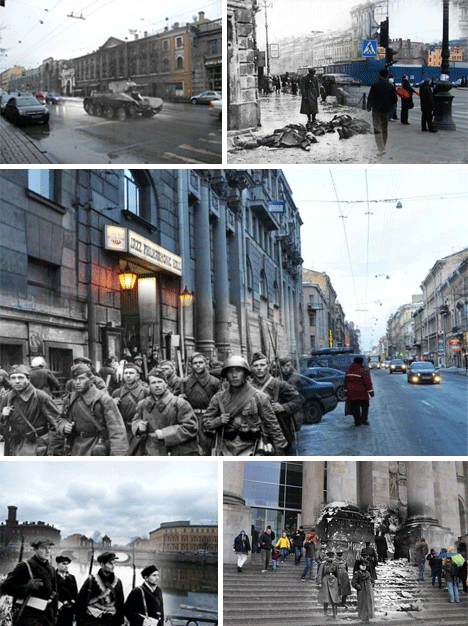
Sergey Larenkov


(Images via drug-against-war, amazingdata, exploringdystopia, boingboing, englishrussia)
Sergey Larenkov scours archived photographs and then locates the exact position they were taken from. By mixing the modern and past photographs he gives a remarkable glimpse between how similar (and different) locations and people can be.

(Images via rolleiflex, ancathach, en-derin)
Concentrating mostly on times of military struggle, like World War II, Sergey Larenkov brings wartime to the contemporary peaceful streets. Seeing tanks rolling down a highway is much more poignant with the modern connection.

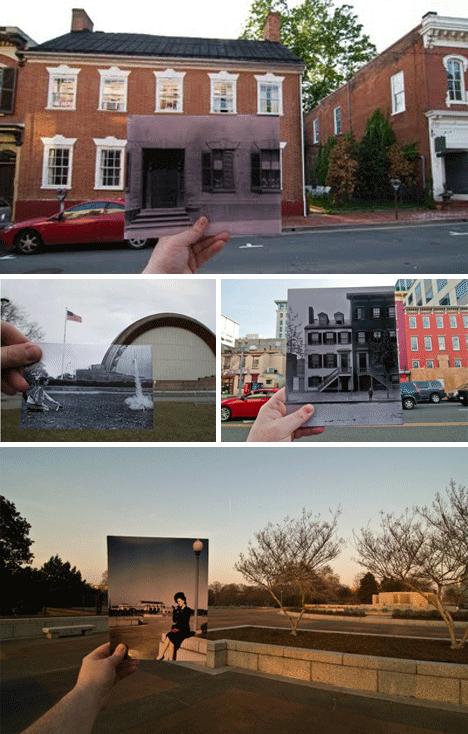
Jason Powell – Looking Into the Past


(Images via camillereads, joshharris, mymodernmet, damncoolpics)
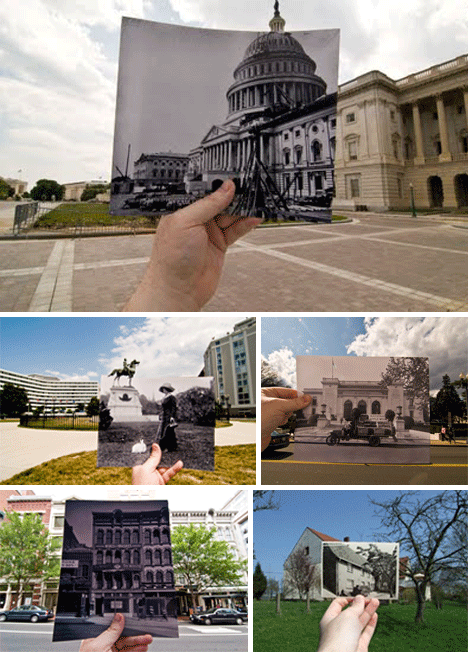
Jason Powell’s flickr pool is called “Looking Into the Past” and places old photographs in their modern locations. The changes are often drastic, but more often, surprisingly similar.

(Images via camillereads, designerscouch, fotozup, lawrenceotoole, designloops)
Everything from recent construction to changes in vehicles and fashion are revealed by these portals into the past. There’s something beautiful about viewing an old photograph exactly as the original photographer first saw it.

Wednesday, March 9, 2011

interactive museums

I found this interesting article about engaging visitors on the website of the JFK library and museum- check it out here.  It's a growing trend that museums, libraries and heritage places are using interactive technology to engage audiences both on site and on the web, perhaps accessed after the visit to show some of their experience with others.

This particular example from the JFK library and museum is great for anyone particularly interested in his career, the politics of the 60s and Kennedy's life generally. I really enjoyed listening to the secretly taped conversations and seeing footage of his campaigns, especially Jackie speaking Spanish to target that demographic.

Friday, January 28, 2011

Back already!

I found out this interesting historical fact today and wanted to share it. On the 28 January 1958 the Lego company patented their design of Lego bricks, still compatible with bricks produced today (source http://www.historyorb.com/date/1958/january/28). Pretty cool huh?

So in honour of this anniversary it may be time to embrace or even find that stash you had as a kid and make something.
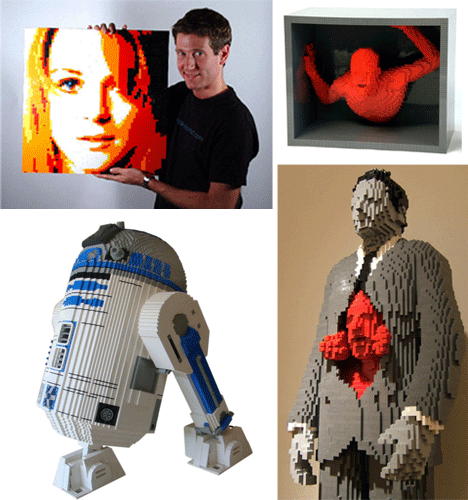
It could be something small

or big  File:Trafalgar legoland Copyright2003KTai.jpg

or amazingly creative


See more of Nathan Sawaya's work here.
 
And all this with these bricks

Thursday, January 27, 2011

TTFN

This is the last official blog post for the web 2.0 course but I'm sure I'll still share some of the interesting things I find in the world of heritage and museums. So stay tuned if you've been enjoying the posts.

I've really enjoyed the course and finding out about all these different ways to communicate with the world. I've learnt so much each week about things I didn't know anything about and it was great to get some hands on experience with the services that I knew about but hadn't actually used. I'm so grateful to City of Swan libraries for setting this up and inviting us all to participate.

The videos were really useful in explaining how and why you would want to use the technology in a fun and informative way. Now I just need to keep using them and finding out what else is out there. I would encourage my workplace, when/if we're able, to use various services such as podcasting, wikis and blogs. I would love to say we'll use them all but if we could even get one going it would be great.

TTFN

Geocaching

Well this is the one activity I've just researched, until I can get my hands on a GPS or smartphone (hmmm). Looking into geocaching, it sounds like a really fun activity to explore familiar and maybe some not so familiar places. I really liked the Scoot game using locations around Melbourne to encourage people to explore their city. 
I have also found another geocaching based game developed by the Powerhouse Museum around Chinatown in Sydney. It's called China Heart and uses four objects from their collection as well as locations to tell a story.  While not strictly geocaching where you go to a location to find a secret cache, you go to a location to get more or understand more of the story.


definitely think that geocaching could be used in libraries, museums or even as part of a heritage trail. The caches could be part of a holiday activity or as a theme to get visitors thinking about a different angle to the collection or place.

Sunday, January 16, 2011

Podcasting

Well I haven't been very successful in my search of favorite podcasts which is why I've delayed posting this blog. I subscribed to a couple on the ABC's site but no new material arrived :-( 
Hopefully with the start of regular programs this week they might come through.


However I looked up the other ones suggested and liked the 60 second scientist but didn't really want to listen to an hour long lecture at home as per the other sites and some museum sites I went exploring on. However I have listened to lectures via podcast for uni which was very useful. Also very useful is Meet Me At Mikes vodcast of how to crochet (I tried teaching myself by pics in a book unsuccessfully) and with the video I know where I was going wrong (yay) - too few pics in the instructions.


The best thing about podcasts is you can listen/watch them via phone or MP3 player (if you load them onto it) anywhere you like. Recent heritage trails are taking advantage of this technology and designing podcasts for people to access via their mobiles. Heritage Perth has one for some of the buildings in the CBD using wifi spots. Another example is the tree museum along the Grand Concourse in the Bronx, however you have to phone a number to get the info. This trail has recorded the living heritage as well as historical sites along a four and half mile road. 100 trees were chosen by the artist Katie Holten and each tree has a linked oral history audiences can listen to.


So on the whole podcasts are pretty useful things.

Sunday, January 9, 2011

online video

Looking at the examples given I liked the way the libraries were using a video to provide more information about a particular topic such as the Topeka Public Library or the National Library providing the audio from a book launch. These are really good ways to utilise you tube for public libraries, however I do like it when information can be given with a bit of flair. For example the Goggle Vision: using electronic resources  http://www.youtube.com/watch?v=5slpJMRWKA8&feature=player_embedded which I found on Make, Collect and Do's blog in the early days of this training. And of course I love Lee LeFever's in plain English videos each week.

As someone else has suggested using videos like the one above as a short tutorial on various topics would benefit library users, although I'm not sure how effective videos would be for museums other than in a documentary style. Not that that's a bad thing, the UK National Trust use you tube to showcase conservation projects, properties and past events. So to summarise there are some pretty interesting things being put on You Tube amidst all the rubbish.

Now for the video I chose. Rather than something a bit academic I thought of a fun song that you can get stuck in your head :-)
Its a blast from the past - The Monster Mash. Hope you enjoy it.

Monday, January 3, 2011

facebook and twitter

I have used Facebook for a few years now, but am usually an observer of friends lives than actively posting about my life. I guess I like to only share some things online and am really pretty private. As part of this week's exercise I had a look at how libraries and museums are using Facebook which I was pretty interested in. Like blogs Facebook is a good way to give information to a target audience and hope that others will discover what you're doing. For example the State Library's posts of the Library of Lost Moments exhibition and the National Museum of Australia's page. So it looks like a good way of advertising what's on and showing some images to draw people into the physical site.

Twitter was something I hadn't used before as I couldn't really see the point of posting what I was doing all the time. I liked Adam Hills summary of it on the recent Very Specky Christmas when he said that Twitter was like everyone shouting about whatever they liked, all at the same time around the world ( I may have paraphrased this slightly wrong but the sentiment is correct). Like Facebook my initial reaction is who cares what I'm doing unless they actually know me, and even then I think there's some disinterest. And yes I know this is exactly what I'm doing writing this blog, even though its for training purposes.

However I'll keep using twitter to educate myself and I have found a monthly book group thanks to Saire and the Swan Libraries tweets, and who knows what else I'll find. For example here's how  the JFK museum and library and the Scott Polar Research Institute at the University of Cambridge are using Twitter to make the past come alive.

@JBK1960 Follow Jacqueline Kennedy's Campaign Wife newspaper column -- 50 years later. Constructed by the JFK Library from transcripts of the 7 syndicated articles.

@scottslastexp Follow Scott's last polar expedition

Sunday, January 2, 2011

a new future for our past?

I came across this today from one of my RSS feeds and thought it posed some interesting questions relating to the use and reuse of heritage buildings. The Michigan Theatre, built in 1926, was once an impressive building on the site of the garage where Ford built his first car prototype, according to www.detriotfunk.com . It was saved from demolition in the 1970s but was gutted and is now used as a car park. Looking at the pictures on either website you can see the amazing interiors and details of the former theatre which was described as a jewel and had 10 foot chandeliers.
While the reuse of a building deemed to have heritage significance is best practice, I don't think this is what any professional in the heritage industry would like to see.  Ironically there is now probably greater access to this building than there would have been when it was a theatre. I have such mixed feelings about this building and its treatment, but it is an interesting urban environment to explore so I thought I'd share it.

(from Wikipedia)

Wednesday, December 29, 2010

an interesting exhibition

I found this interesting article during last week which made me stop and think, like a pebble in the road I wanted to have a closer look at. Its an apron exhibition at the Vandergrift Museum in the US.  All the aprons were sourced from people who lived or had lived in the Vandergrift area and it was great that not all of them were domestic aprons. There was an anatomy and Dairy Queen apron, and a Christmas apron. The aspect of the exhibition I liked the most was that the exhibition wasn't just about the aprons and the technical side to their creation, it was predominantly about the stories behind them, the interpretation.

Bringing together what seems to be an ordinary, everyday object can start people talking about so many different things - for example the changing to domestic life and the role of women, arts and crafts skills, changes in clothes; just to name a few of the more obvious ones.

The interpretation of objects is the important aspect of having a collection of objects, without it the objects are meaningless and storerooms would resemble junkrooms.

Wednesday, December 22, 2010

Delicious and Library Thing

Well this week's exercises have had some surprising results, I didn't expect much from the two sites but was pleasantly surprised. I had previously looked at Delicious before doing this training and thought well that's a waste of time, who wants to create a favourites list online? Having a look at the suggested examples gave me a better understanding of the benefits of the site such as tagging, finding other sites people have listed and finally being able to access my favourites from any computer. Its actually pretty interesting seeing where the threads in the form of tags take you, although sometimes you can get so lost you don't know where you started from but I guess as in many things the journey of discovery is the most important thing. I also looked up some of the blogs I'm following and saw what they listed (and pinched a few, but they're there to share so its ok).  Just heard from GozzieHoon that Delicious will be no more, aww just when I was getting into it.

Library Thing was also interesting to explore. I set up an account (for the purposes of the training) and added a few books to play with the site's features. I already have an account with Goodreads which is very similar. However there are some benefits I saw with Library Thing over Goodreads is that you can add tags, helpful if you want to find other books in that genre, there is a local element that shows where the nearest libraries and bookshops are and there are actually links to other sites if you look up an author. I've added the books to my blog (which was a bit frustrating, but now I have learnt a new skill) so you can see the random selection. To defend Goodreads I like the format of that site better as you don't have to go to another page to see other people's reviews.

I think both sites have benefits in a professional library context, however I think its the first time where I can't see a benefit to a heritage institution, unless they use Delicious or an equivalent to link to other sites that are similar.

Thursday, December 16, 2010

really wiki(d)

I have to say that looking at the suggested sites didn't really do anything for me so I went on a quest to find out what museums are doing with wikis. The results are interesting.
One of the blogs I've stumbled on is Museum Next which is all about the use of technology in museums - yay. One post features an exhibition which uses ipads to provide information via Wikipedia on the featured artists. http://www.museumnext.org/2010/blog/what-can-the-ipad-do-for-museums. I really like this idea as its easily updated and can link to other sites if you want more information. Coincidentally I found another blog post about this same exhibition from the host museum - the Brooklyn Museum.
http://www.brooklynmuseum.org/community/blogosphere/2010/10/14/bklynflow-on-github/

Another museum with a more local focus is the Amersham Museum in England which wants people to add their information about the place much in the same way as wikipedia works, although this is controlled and you have to apply to get the password to upload information. I think this is a great idea which got me interested in wikis again as a tool to connect people and information. I'm finding professionally there are people in the community who know about objects in a museum/local studies collection that staff don't necessarily have the knowledge, so instead of putting in a can you help ad in a newspaper, a wiki could help to expand the knowledge of the collection, while making it digitally accessible. Also people contributing can also provide their own stories about using/seeing the object used or background information on a photo. The Science Museum had this in mind with their object wiki where you can look up an object in their collection for example: http://objectwiki.sciencemuseum.org.uk/wiki/Vespa_Sportique_Scooter
or this one where people have added their memories of using the object (might bring back some memories of people out there):
http://objectwiki.sciencemuseum.org.uk/wiki/Macintosh

A new site is www.nowandthen.net.au where Collections Australia Network (CAN) have teamed up with a local museum in Mallala, SA for a trial wiki which "utilises wiki technology to allow local communities to record, explore and share information about their history and life today. All members of the public are invited to contribute and edit entries on particular communities and the places, people, events, organisations and things that make them unique."
The Our Page In History run by the WA State Library Foundation is along the same lines as the now and then site as it is digitising the collection and asking people to contribute their knowledge.  Or perhaps this is a little off the track of wikis?

Sunday, December 12, 2010

RSS -really super system

After setting up the feeds for my favourite and new favourite websites I couldn't wait to see if there were any new updates. Here's some of the ones I subscribed to:
I added two of the suggested ones from Google reader which were on design and architecture,
http://design-milk.com/
http://weburbanist.com/

two from the Powerhouse museum - object of the week and photo of the day (a great use of getting the collection out there to everyone in webland),
http://www.powerhousemuseum.com/imageservices/
http://www.powerhousemuseum.com/collection/blog/

as well as a few others on museum and crafty themes
http://www.museummarketing.co.uk/
http://thecraftyminx.com.au/

I really like the idea that you don't have to keep on looking at your favourite websites, only to find that there's nothing new - I used to do this and get frustrated. So having the information come to me is great, its like getting mail everyday (or not depending on the website but that's ok)- good mail, not bills. Also as a test I decided to subscribe to a site which I get weekly emails from just to see how they are different. I'm glad I did because I was missing out on so much content which featured on the website that they didn't include on the email. Another good feature is that the info on the posts are included in the list of new items so if it doesn't sound interesting you can just skip over it.

So based on this test for a week I think I can extrapolate a result and say that RSS feeds are useful in my work life as a better way of letting people know what's happening or what's new and exciting in your library/museum/other than sending/producing newsletters. So with as much effort as writing an email (with a bit of thought to the content of course) all the people out there interested in your museum/library/place can get updates without the need to wait for enough information to put out a newsletter. 

I can see the following benefits from RSS feeds:
  • information comes to me and I don't get frustrated that I'm constantly checking sites which aren't updated as often as I look at them
  • a mailing list doesn't need to be maintained by a workplace to send out newsletters
  • depending on the workplace it may be easier to write a blog post than design/input information into a newsletter template
To summarise there are benefits to both the end users of websites as well as those creating the content. That's got to be a good thing for everyone who is time poor at work/home.

Wednesday, December 8, 2010

Museum/heritage moments

After reading this story from The Guardian, which I found on Global Museum, that talks about local museum funding and the importance of local museums; I thought about the museum/heritage moments of my life. The one that comes to mind first is obviously the Propert pink caravan as the museum moment of my 2007 visit to the National Museum. On my latest visit, perhaps due to much of the collection being stored during the refurbishment, my museum moment came from a touring exhibition from WA. The exhibition was Yirwarra Kuju: Canning Stock Route and consisted of paintings of artists living along the old stock route. If you get the opportunity to see it, go for it as it gives an interesting view of Indigenous history, life and art in a very remote landscape.

Locally my favourite object at the WA Museum is the buffalo who is part of the Museum's heritage collection. This is due to it being among the early museum exhibits still on display and the way the exhibition objects are displayed. The buffalo is an object that a lot of people remember on their visit, no matter what their age and it is fascinating to see an animal that big up close. Check it out next time you're in the museum.  In Maritime museum Shipwrecks Gallery its definintely the Batavia exhibition which I saw for the first time in primary school. The exhibition and story behind this shipwreck is interesting, blood thirsty and tragic and is an important part of WA's history. A book on the subject is
Hugh Edward's Islands of angry ghosts : murder, mayhem and mutiny : the story of The Batavia.

Unfortunately I can't find any images of these exhibitions to inspire you to visit, but here's one of the museum facade from the James Street in the cultural centre.
WA Museum

My question to you all in blogland is what are your museum/heritage moments?
Maybe you haven't had one yet so I encourage you to get out there and find out about something you already enjoy - there'll be a museum somewhere in the world for you.

Friday, December 3, 2010

Flickr

After agonising over finding an image for the past week, today I finally had a breakthrough and found one partly due to something GozzieHoon said to me yesterday about my favourite place in Perth. While I don't have a definite favourite, here is an image of somewhere I love in Perth. 

http://www.flickr.com/photos/dinlin47/3570429682

The image shows the magical time of the change in light late in the day as shown in the photo when the colours of the trees are enhanced and the undergrowth is in shadow. 
Hunting around on Flickr I looked at some of the cultural institutions' images under The Commons which is a great way of sharing these items from the collections, such as the Brooklyn Museum's Egyptian lantern slides from the turn of the 20th century.
Sphinx

modern image of the Sphinx

I also liked how people have posted similar images in their comments which shows the changes over time of these places. I had seen these images before in Archaeological Diggings magazine and looking at the images I imagined how amazing they would have been to an audience, I'm thinking Europeans, who wouldn't have seen anything like it. The craze for all things Egyptian continued in decorating and fashion design took off in the 1920s and 1930s, after seeing images like these. Also due to the archaeological finds occurring at the time such as Tutankhamen.

You can see the influence here in one of the Powerhouse swatches.

Another thing I love about the lantern slides is the tinting, a light wash over the image to suggest the colours. Not quite the true life colouring we expect from today's latest technology but back then it would have been very evocative for the viewers.

So after all this I can see the benefit of adding images from library and cultural heritage institutions to better allow access and as a way of utilising a web service, rather than storing images on their own website. I guess the only issue is with copyrighting and that seems to be sorted by the Creative Commons.

Saturday, November 27, 2010

the first post

Just to clarify, this blog will not be about caravanning. The inspiration for the title came from the Propert 'Trailaway' touring caravan which is part of the National Museum of Australia's collection. The caravan was built in 1956 and is very cute as you can see here http://www.nma.gov.au/collections-search/display?irn=9022. Unfortunately it is currently not on display, so I couldn't get my retro fix last time I visited the Museum, but I bought a postcard picture of it so I can see it whenever I want. It even became my desktop pic for a while. Anyway I'll stop going on about the caravan, but I thought it was important to clarify this point and to save disappointment for all those caravanning enthusiasts who may stumble on this blog.

I'll talk about other interesting things in the world of heritage and museums, as well as my progress through the Western Australia Public Libraries -Learning 2.0 basics training. I'm pretty excited to participate in the training to use these technologies as I'm a bit of a novice to some such as blogs. I've recently started looking at blogs out there -mostly at this stage they're crafty/vintage ones which have pretty pics and some inspiration. I'm yet to discover any on a heritage type topic but I'm sure they're out there, yet to be discovered.

As you may guess I'm not a librarian but work in heritage within a library environment so I have become familiar with some of the aspects of that world, its somewhere I can dip my toes into but when it gets complicated I bail and say 'sorry I'm in heritage, you'll have to ask a librarian'. I think that the technologies presented in the training will become more useful in the library and heritage professions as clients can have more interaction with collections and share these aspects they discover with others, just like I have with the pink caravan. Another interesting site is the Powerhouse Museum which has online access to their collection. I especially like the swatch book http://www.powerhousemuseum.com/electronicswatchbook/ which contains fabric swatches from the late 1830s to the early 1920s.
So that's about all for this first post, hope you enjoy exploring the links and making your own connections with these awesome collections.